


**To Build or Not to Build...That is the Question.**
** Should a LEGO Collector Open and Build a MISB Set?**
Over the past five years, BrickPicker has aggregated millions of eBay LEGO sold auctions to come up with our LEGO Set Price Guide. Each month, a "New" and "Used" value is calculated and recorded, but 99.99% of the time, the "Used" value is irrelevant to the BrickPicker forum discussions. The topics almost always discuss Mint In Sealed Box (MISB) LEGO sets and their potential as a collectible or investment. But it's not only on the BrickPicker forums that used LEGO sets are ignored. Almost every popular LEGO forum and their hundreds of thousands of members seem to overlook the fact that LEGO sets are valuable in used condition. For clarity's sake, I would classify any LEGO set, in which the box is opened and the bricks removed from their clear plastic baggies or polybags, as used. The set should be complete, with all pieces and instructions, in good condition. A LEGO box need not accompany a "Used" LEGO set, but it could add some value to more iconic sets. What other toy do you know of that can actually increase in value after being opened up and played with? Not too many, I would imagine, but LEGO sets and bricks are one of them. Let's take a look at the chart below which lists (in order) the Top Ten Most Valuable Used LEGO sets at the moment and their Return On Investment percentage (ROI%) from retail/MSRP:
As the reader can see, many of these "Used" LEGO sets sell for thousands of dollars/pounds even after they have been opened, played with, displayed and possibly even chewed on. LOL. The Return On Investment percentages for many of these noteworthy LEGO sets are nothing to scoff at. Many of these larger and memorable LEGO sets are two, three, four, five...even six times the MSRP of the set. Granted, these are some of the biggest and the best that LEGO has to offer, but smaller and less expensive LEGO sets also can appreciate to levels higher than the original MSRP of the set. For instance, a run of the mill CITY set like the 7893 Passenger Plane can triple from its $39.99 MSRP to well over $130.00 (US). A small and inexpensive Architecture set, the 21001 John Hancock Tower has tripled in value from its $19.99 MSRP to over $60.00. Even Hero Factory sets see nice appreciation after being played with. The 7145 Von 'Nebula has more than doubled in value in a very short time period, from a MSRP of $19.99 to well north of $40.00. Remember...these are USED VALUES...NOT NEW. These are just a few examples of older and retired LEGO sets appreciating in value even after being built and played with. There are hundreds, if not thousands of LEGO sets that are worth more in used condition than they were new at retail. But what is the cost of cracking open and building that LEGO set? Let's take a look at the graph below:
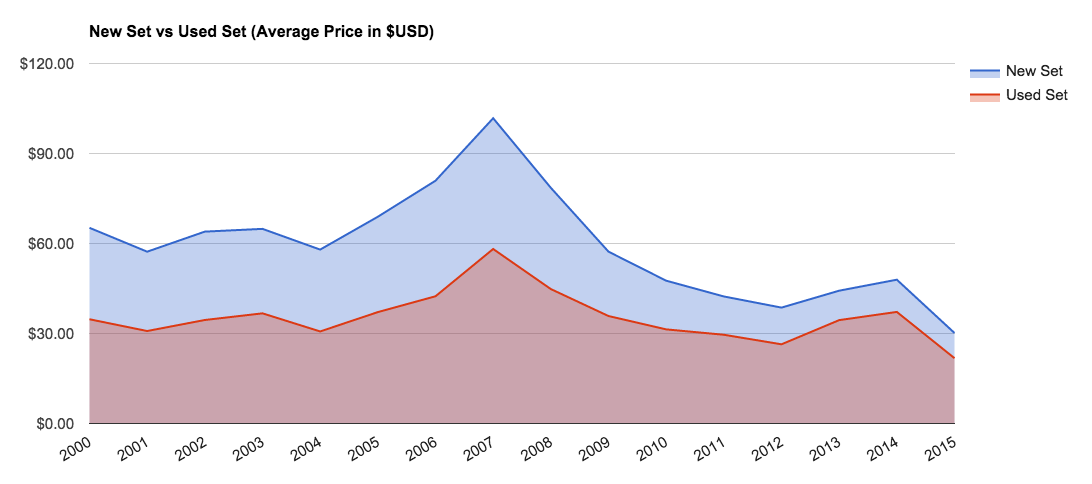
The graph compares the current average prices (from eBay auctions) of all LEGO sets released over the past fifteen years, both new and used values. As you can see, older sets are more valuable because they are retired. You will also notice a large uptick in prices around 2007...the year the 10179 UCS Millennium Falcon, 10181 Eiffel Tower, 10190 Market Street and the 10182 Cafe Corner were released. These four iconic and uber expensive sets have definitely affected the results, yet the spread between new and used values remained relatively constant. There seems to be a larger spread between used and new values with older retired sets and less of a spread with newer and recently retired sets. This can be explained by older retired MISB sets becoming more and more rare as time passes. Many people will spend top dollar for these big ticket sets, but they build them, thus reducing the pool of remaining MISB sets. With each set that is opened and built, the remaining MISB sets increase in value. For simplicity's sake, there is about a 40% difference between new and used values over the past fifteen years, with the difference narrowing with newer sets.
So the question still remains...To build or not to build? Well, as with anything, it's a personal choice. The 40% difference between new/unopened and used/built sets can be substantial...amounting to hundreds if not thousands of dollars or pounds. But considering LEGO sets are really meant to be built, played with and admired and not stockpiled in a closet or shelf, I would say build it. Most LEGO sets will still appreciate to values higher than the MSRP even if they were built. As long as the set remains clean and complete, with all pieces, instructions and boxes, used sets can grow to very high values. On a personal note, I usually buy at least two of each major set...one to save for investment...one to build and display. Many times, in order to save some money, I will even buy a clean used set to build. All in all, there is no losing proposition here. What kind of item or toy can be played with for years and sell for more than one paid for it? Not many...So build it and enjoy the best toy that man ever created...


