


If you have ever tried to answer a simple question like "is this LEGO set actually good?", you know the routine. You open YouTube and start a 40 minute review. Then a second one, because the first reviewer loved it and you want a second opinion. Then you check Brickset's take, skim a blog post, scroll a few hundred buyer reviews on LEGO.com, and somewhere around the eleventh browser tab you realize you still do not have an answer. You have opinions. Lots of them. What you do not have is a verdict.
Movies solved this problem decades ago. Games solved it. Restaurants, hotels, appliances, even mattresses solved it. LEGO, a hobby with some of the most knowledgeable and dedicated reviewers on the internet, never did.
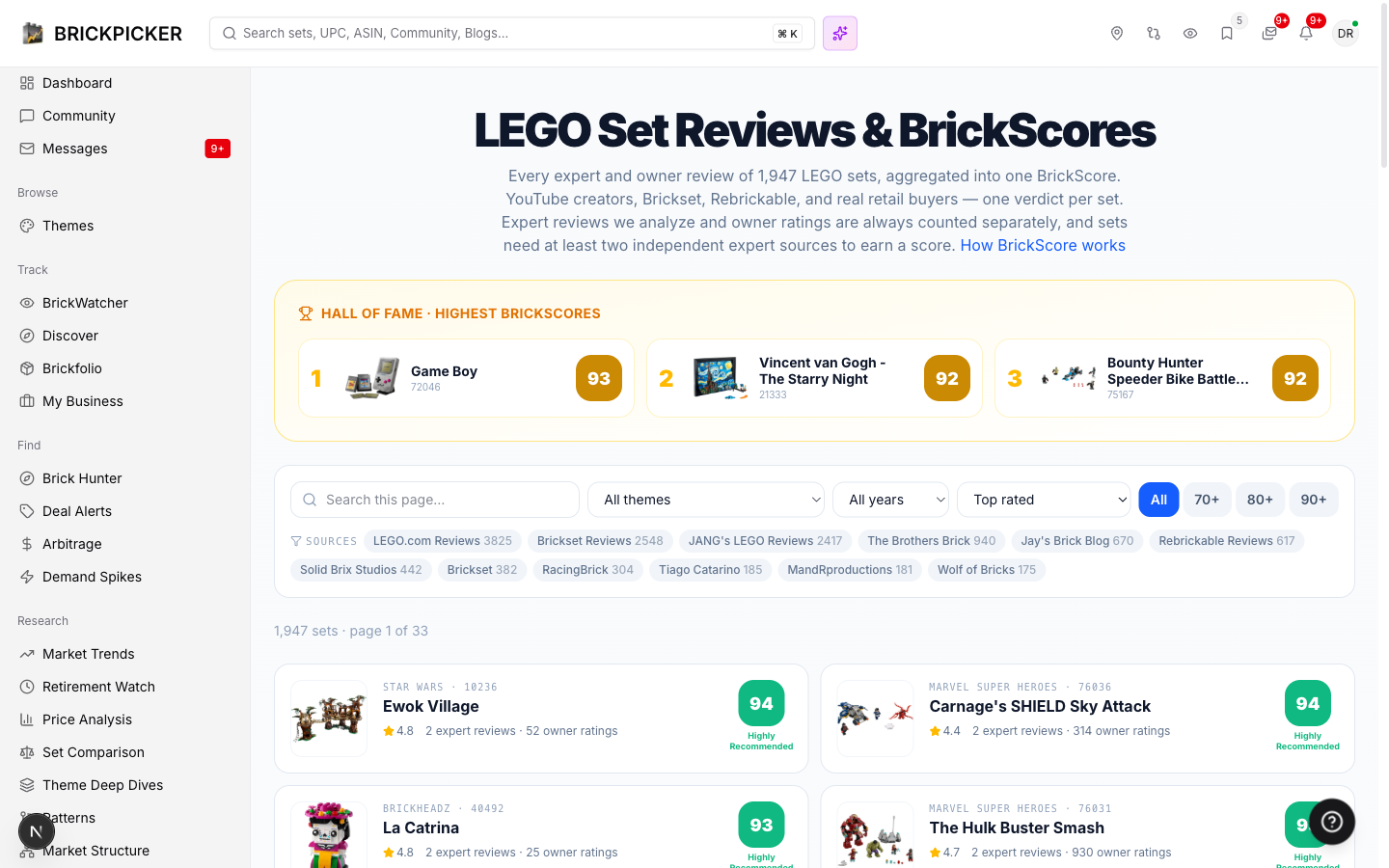
Today that changes. We are launching BrickScore, the most ambitious LEGO review project we have ever built: every expert review we can find, analyzed in depth, scored on a single 0 to 100 scale, and paired with millions of real owner ratings. It lives at app.brickpicker.com/lego-reviews, it covers nearly 2,000 sets across 82 themes and five decades of LEGO history, and the core of it is free for everyone.
What we actually built
A BrickScore is not a star rating and it is not a poll. It is a critic consensus, the same idea that powers Metacritic for games and Rotten Tomatoes for film, built specifically for LEGO.
Here is what that means in practice. For every set, we collect the full written and video record from the most trusted reviewers in the hobby. We analyze each review in depth: the verdict, the reasoning, what the reviewer praised, what they criticized, how they rated the build experience, the parts, the minifigures, the display presence, the value for money. Each expert verdict is mapped to a 0 to 100 score, weighted by the source's track record and depth, and combined into one consensus number.
Then we do something nobody else does: we put that expert consensus side by side with what actual owners think. We track owner ratings from LEGO.com, Amazon, Walmart, and Target, and we never blend the two numbers. When you see a set page that says "5 expert reviews analyzed" and "1,500 owner ratings," those are two separate, honest facts. Critics and owners often agree. When they do not, that disagreement is some of the most useful information in the hobby, and we show it to you instead of averaging it away.
Every score lands in a tier, so the number means something at a glance:
- 90 and above: Must-Have. The acclaimed sets. Only 32 sets in the entire catalog earn this today, and a set needs at least three independent expert sources to claim it. Two enthusiastic reviews are a great sign, but they are not enough evidence to call something one of the best sets ever made.
- 80 to 89: Highly Recommended. Excellent sets with broad critical support.
- 70 to 79: Recommended. Good sets, worth buying for the right person.
- 60 to 69: Mixed Reviews. Critics split, often on price.
- Below 60: Skip It. The sets reviewers genuinely warn you about. There are 154 of them, and we publish every one, because a review platform that never says "skip it" is an advertising platform.
The scale of this launch
We did not want to launch a demo. We wanted to launch a library. Here is what is live on day one, with real numbers straight from our production database:
- More than 120,000 reviews and ratings ingested. That includes the complete analyzed record of expert reviews from 25 trusted sources, plus over 104,000 verified buyer reviews pulled directly from LEGO.com.
- Owner ratings representing more than 5.7 million individual buyer scores across LEGO.com, Amazon, Walmart, and Target, aggregated per set and always kept separate from the expert lane.
- More than 800,000 individual data points extracted from the review record. This is the part we are proudest of, because it is what makes BrickScore more than a number. Across nearly 116,000 scored review mentions, our analysis extracted over 307,000 aspect ratings (build experience, design, parts value, playability, display value, value for money, minifigures), more than 77,000 specific points of praise, over 54,000 specific criticisms, more than 54,000 notable quotes, over 111,000 build observations, more than 43,000 standout part callouts, over 21,000 minifigure callouts, and nearly 12,000 investment signals.
- 1,947 sets with a published BrickScore at launch, spanning 82 themes and releases from 1979 through 2026.
- A written, synthesized verdict on every scored set. Not a wall of numbers. An actual editorial summary of what the critics agreed on, what they fought about, what owners think, and whether the set is worth your money.
We believe this is the deepest analysis of LEGO review content assembled in one place. Other sites aggregate review scores, and we respect the work they do. What we set out to build is something different: a weighted expert consensus, paired with millions of owner ratings, with the reasoning behind every verdict preserved and all of it connected to live market data. As far as we know, that combination has never existed for LEGO before today.
Built on reviewers you already trust
A consensus is only as good as the voices in it. BrickScore is built on the people who have been doing this work for years, in some cases decades: the YouTube builders who put every set together brick by brick on camera, the editorial institutions like Brickset and Rebrickable that have documented this hobby with academic patience, and the independent blogs whose reviews read like they were written by your most obsessive LEGO friend, because they were.
These are reviewers with long histories and real standards. They disclose sponsorships. They criticize sets from a company they obviously love. They notice when a printed slope from 2009 quietly comes back, and they tell you when a $160 set should have been $100. Our job is not to replace them. Our job is to make their work easier to find, fairer to compare, and impossible to ignore.
That is why every BrickScore page works as a directory of the underlying reviews. Every expert verdict on every set page is attributed by name and linked to the original review. If a video walkthrough or a deep-dive blog post is what convinces you, we want you to watch it, read it, subscribe, and become their viewer, not just ours. We built this to give back to the community that built the hobby's knowledge base in the first place. BrickScore sends readers toward creators, never away from them.
And the weighting matters. Not every opinion counts the same in our consensus, because not every opinion should. Sources earn weight through reputability and depth. A reviewer with a decade of consistent, rigorous coverage moves the number more than a drive-by rating. That is the difference between a consensus and a comment section.
The honesty rules we will not break
Review aggregation has a credibility problem, and we knew it going in. So we wrote our rules down, published them on a public methodology page, and wired them into the product so we cannot quietly bend them later:
- Expert reviews and owner ratings are never blended. Two different questions, two different numbers, always labeled. "4 expert reviews analyzed. 1,222 owner ratings." You will never catch us inflating one with the other.
- No score from a single review, ever. A set needs at least two independent expert sources to get a BrickScore. One opinion is a summary, not a consensus.
- Must-Have status requires evidence. A 90+ score with only two sources displays as Highly Recommended until more reviews come in. The score is never bent. The label just refuses to overclaim.
- The score is pure math. A weighted average of expert verdicts. No curve, no bonus points, no nudging toward a comfortable middle. If every critic says 93, the set scores 93. If they say 32, we publish 32.
- No pay for placement. Scores cannot be bought, and affiliate links never influence a number. The Skip It tier is full of sets we could have made money promoting.
- Disagreement is content, not noise. When critics split, or when critics and owners split, the set page says so explicitly. Some of the most interesting sets in the catalog are the divisive ones.
What this looks like on a real set
Take the 2025 Death Star, one of the most polarizing sets LEGO has released in years. Its BrickScore is 62, squarely in Mixed Reviews territory, across 10 expert reviews from 8 sources. The synthesized verdict tells you why in two sentences: a technically ambitious, scene-rich showpiece let down by a $999.99 price tag. The owner data deepens the story: Amazon buyers rate it 4.5, but LEGO.com buyers, the hardcore fans who paid full freight, rate it 3.39, with a value-for-money signal of 2.8 out of 5 and only 59 percent saying they would recommend it.
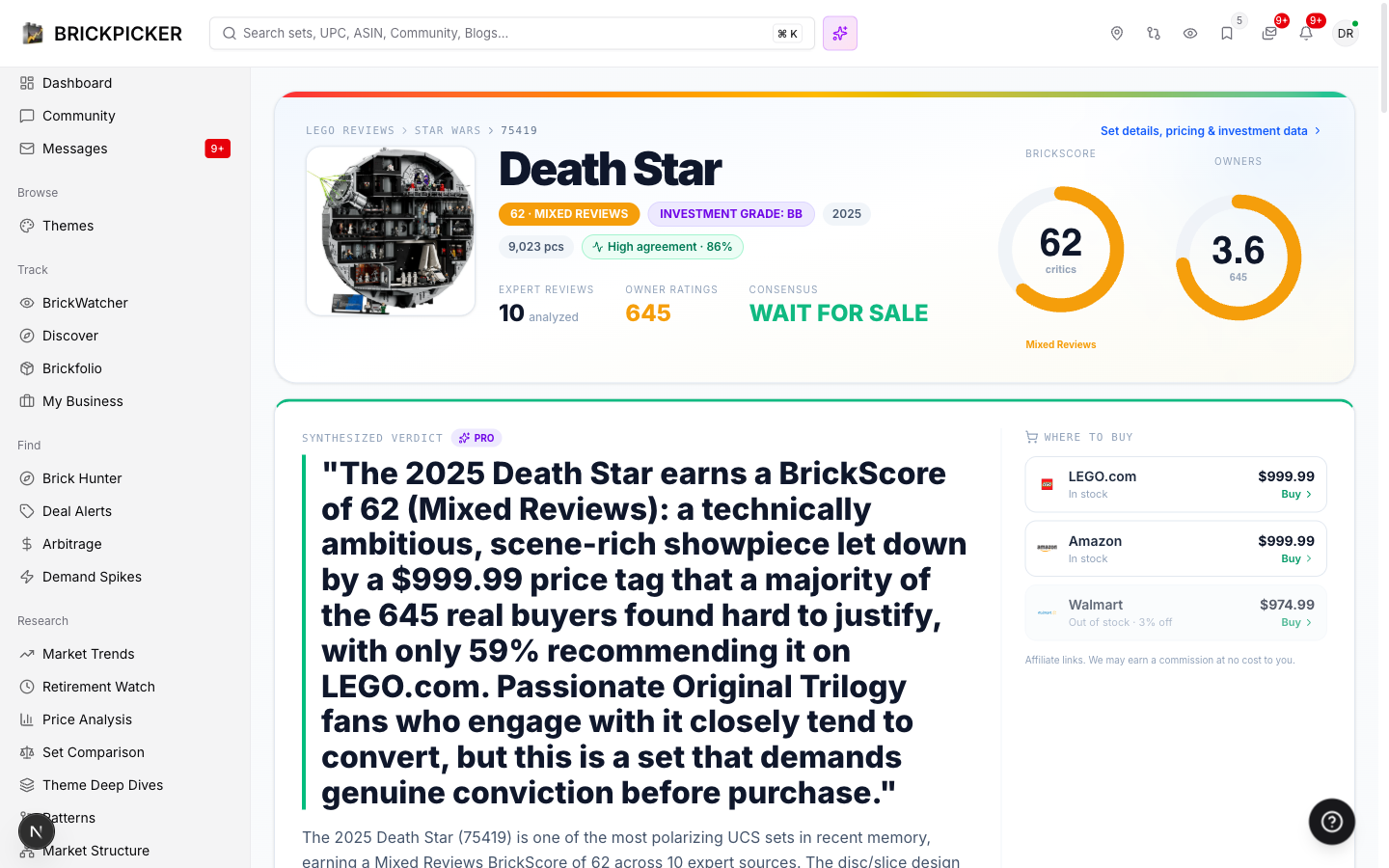
That is a complete picture you simply could not get anywhere else without hours of research: what critics think, what owners think, where they disagree, and what it means for your wallet. Every scored set in the library gets this treatment. The praised points, the criticisms, the standout minifigures, the notable quotes with attribution, the build notes, and a confident verdict at the top.
How to read a BrickScore page
Every review page follows the same anatomy, designed so you can get the answer in ten seconds or go as deep as you want.
At the top: the score, its tier, and the two honest counts side by side, expert reviews analyzed and owner ratings. Right below sits the synthesized verdict, the one or two sentence editorial take, followed by a fuller consensus summary. Then the structure opens up: what reviewers loved and what they criticized, each point synthesized from the actual review record rather than copied from a single source. Standout features call out the parts, techniques, and minifigures reviewers flagged as special. A value section grounds the price conversation in real numbers, price per piece, comparable sets, and what owners said about value for money. When critics disagreed with each other, or critics and owners split, a divergence note says exactly where and why.
Below all of that, the individual expert takes: each reviewer's verdict, their key points, and a link to the original review. And because a review should lead somewhere, every page links straight to the set's full BrickPicker detail page, with live pricing, retirement signals, and market history, plus a row of similar sets in the same theme to keep you exploring.
The aggregate hides nothing. You can always drill from the single number down to the exact sentence a reviewer wrote.
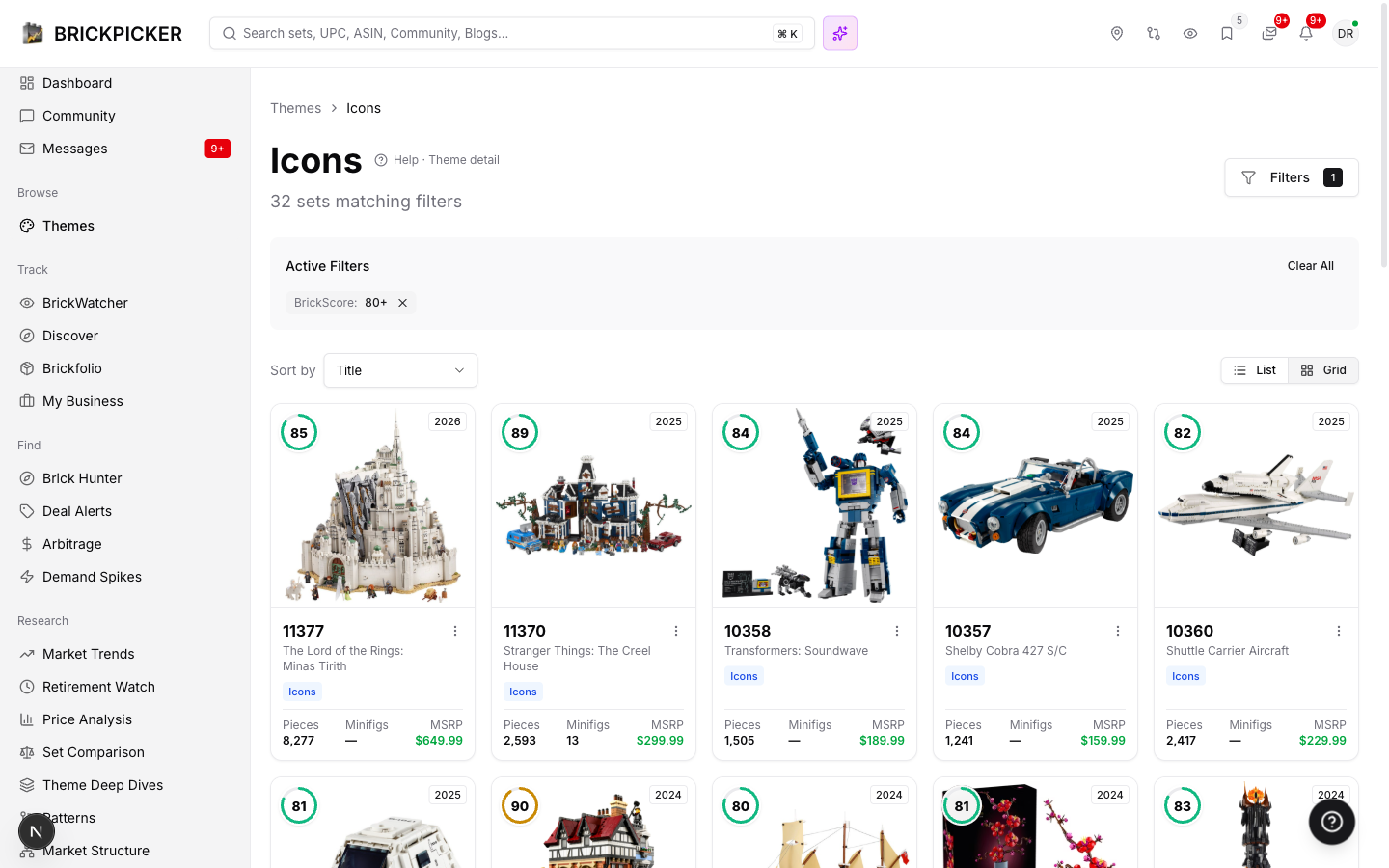
BrickScore also follows you around the rest of BrickPicker. You will see tier-colored score dials on theme pages, a full review module on every set detail page, the highest-rated sets on your dashboard, and even an average BrickScore for your own collection inside Brickfolio.
Free for everyone, with one premium layer
Everything described so far is free. No account games, no trial clock, no "first three reviews free." Browse the full library, filter by theme, year, and score tier, read every synthesized verdict, see every critic and owner number. We want BrickScore to be the default answer to "is this set good?" for the entire community, and a paywalled default is not a default.
There is one layer reserved for BrickPicker subscribers: the Max Profit Opinion. This is where BrickScore meets the other half of what BrickPicker does. For subscribers, every reviewed set also carries our house investment take: the reviewers' value and retirement claims, cross-checked against our own market data, including eBay sold comps, BrickLink pricing, our growth and liquidity scores, and our retirement model. When a reviewer says "this will be a great investment after retirement," our data either backs that up with numbers or politely disagrees. That analysis layer, connected to a live market dataset, is something no review site can offer, because no review site has spent years building the market engine underneath it.
If you are here purely for the reviews, you will never hit a wall. If you are here to invest, the Max Profit layer is the sharpest tool we have ever shipped.
A library that keeps growing
Launch day is the starting line. The pipeline that built this library keeps running: new reviews are ingested and analyzed continuously, scores recompute automatically as new verdicts land, and owner ratings refresh as buyers keep buying. A set's BrickScore today reflects the record today. Next month it will reflect next month.
We are also going to keep widening the source list. Twenty-five trusted sources is a strong start, and we know the community knows reviewers we have not indexed yet. The German blogs. The technical channels that only review Technic. The vintage specialists documenting sets from before some of our reviewers were born.
If there is a reviewer or site you trust and want to see in the consensus, email [email protected] with a link. Every suggestion gets a real look. The bar is simple: a track record of genuine, independent LEGO reviews. If they meet it, we will build them into the library, with attribution and links, the same as everyone else.
Why we built this
BrickPicker has always been a data company for LEGO people. We track prices, retirement signals, deal feeds, and portfolios. But the first question anyone asks about a set has never been "what is the CAGR?" It is "is it good?" For years that question has had no canonical answer, just an ocean of excellent but scattered opinions.
So we built the machine that reads everything: more than 120,000 reviews and ratings, over 800,000 extracted data points, nearly 2,000 scored sets, every verdict weighed, every disagreement preserved, every source credited and linked. Then we wrapped it in rules that keep us honest and gave the core of it away for free.
The experts did the hard part over many years. The owners did their part five stars at a time. We did the math.
Go see what the consensus says about your favorite set, your grail, or that one set everyone claims is overrated. Start at app.brickpicker.com/lego-reviews, check the Hall of Fame, browse the Skip It tier for fun, and tell us what we should index next.
The verdict is finally in one place.


